Operating Lease vs Finance Lease: Which Is Better for Your Business in 2026?
Growth is the goal, but how you fund that growth can make or break your balance sheet. Whether you’re a startup in Shoreditch needing the latest MacBook fleet or a manufacturing giant in the Midlands looking at heavy-duty CNC machines, you’ve likely bumped into the two titans of asset acquisition: the Operating Lease vs Finance Lease.
For years, the choice was simple: one was basically a long-term rental, and the other was a path to ownership. But as we step into 2026, the landscape has shifted. New accounting standards (like the revised FRS 102) have brought almost all leases onto the balance sheet, meaning the “hidden” perks of leasing aren’t so hidden anymore.
So, in this new era, which should you choose? Let’s dive into the operating lease vs finance lease debate and see which one deserves a spot in your business plan.
The Operating Lease: The Ultimate “Flex” for Your Cash Flow
Think of an operating lease service as the high-end equivalent of a long-term rental. You pay to use the equipment for a set period—usually much shorter than the asset’s actual lifespan—and then you hand it back.
Why Businesses Love It:
- Avoid Obsolescence: If you’re in tech, you know that today’s “state-of-the-art” server is tomorrow’s paperweight. Operating leases allow you to upgrade to the newest models every few years.
- Lower Monthly Costs: Because you aren’t paying for the full value of the asset (only its depreciation during the time you use it), the monthly payments are typically lower than a finance lease.
- Maintenance Included: Often, the lessor handles the repairs and upkeep. If the machine breaks, it’s their headache, not yours.
The 2026 Reality:
Previously, operating leases were “off-balance sheet,” making your company look less leveraged. Now, under the new UK rules, you still have to record a “Right of Use” asset and a corresponding liability for most leases. While the accounting is more transparent now, the operational flexibility of an operating lease remains its biggest selling point.
The Finance Lease: The Strategic Path to Ownership
A finance lease service is effectively a “buy-now-pay-later” plan with a twist. It’s a long-term commitment where you essentially pay for the full value of the asset over its useful life.
Why Businesses Love It:
- Control and Ownership: While the leasing company technically owns the asset during the term, you usually have the option to buy it for a “peppercorn” fee (a tiny, nominal amount) at the end.
- Long-Term Assets: This is the go-to for equipment that lasts a decade or more—think heavy plant machinery, commercial vehicles, or specialised medical gear.
- Tax Benefits: You can often claim capital allowances and deduct the interest portion of your payments from your taxable profits.
The Trade-Off:
You are responsible for everything. Maintenance, insurance, and taxes fall squarely on your shoulders. If the machine stops working, you still have to make those payments.
Finding the Right Partner: Best Asset Finance UK
Choosing between these two is only half the battle; the other half is finding a lender that doesn’t treat you like a number. In the crowded UK market, Best Asset Finance UK has carved out a reputation for being the “common sense” broker.
What sets a firm like Best Asset Finance UK apart is its ability to look past the rigid “tick-box” criteria of high-street banks. Whether you need a bespoke finance lease service for a fleet of electric vans or a flexible operating lease service for a new office fit-out, they specialise in tailoring the repayment structures to your specific seasonal cash flow.
In 2026, when interest rates and accounting rules are in flux, having a partner who understands the nuances of the UK SME sector is a massive competitive advantage.
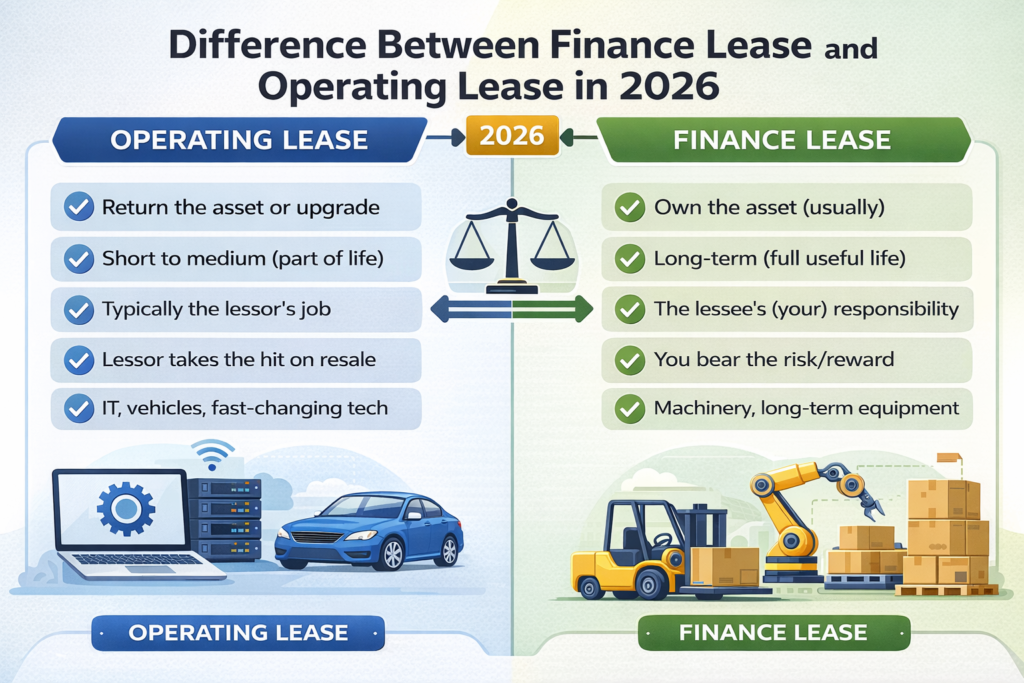
Difference Between Finance Lease and Operating Lease in 2026
| Feature | Operating Lease | Finance Lease |
| End Goal | Return the asset or upgrade | Own the asset (usually) |
| Lease Term | Short to medium (part of life) | Long-term (full useful life) |
| Maintenance | Typically the lessor’s job | The lessee’s (your) responsibility |
| Risk of Value | Lessor takes the hit on resale | You bear the risk/reward |
| Best For | IT, vehicles, fast-changing tech | Machinery, long-term equipment |
The Crucial Role of Asset Management & Expert Advice in Easy Way
Deciding between an operating lease vs finance lease isn’t just a math problem; it’s a strategic decision about your company’s future. If you choose an operating lease service, you are prioritising agility and the ability to pivot as technology evolves.
Conversely, opting for a finance lease service is a commitment to building long-term equity in your business infrastructure. Navigating these options requires a deep understanding of current UK tax laws and asset depreciation.
This is where a specialised firm like Best Asset Finance UK becomes invaluable, helping you weigh the “total cost of ownership” against the “total cost of usage.”
Also Read:- Asset Finance for Business: Choosing the Best Funding Option
FAQs
Q. Does an operating lease still keep debt off my balance sheet in 2026?
Ans:- Generally, no. Under the new FRS 102 standards, most leases (except very short-term or low-value ones) must be recognised on the balance sheet. However, they still offer better “operating” cash flow appearances than traditional loans.
Q. Can I end a finance lease early if I don’t need the equipment?
Ans:- It’s difficult. Finance leases are usually “full-payout” and non-cancellable. You might be able to settle early, but you’ll likely have to pay a significant portion of the remaining interest.
Q. What happens if the asset I’m leasing on an operating lease gets damaged?
Ans:- You are usually required to return the asset in “good condition, allowing for fair wear and tear.” If there is significant damage, you will be hit with a bill at the end of the term.
Q. Which is better for tax purposes?
Ans:- It depends on your profit levels. Finance leases allow for capital allowances, while operating lease payments are usually treated as a fully deductible business expense. Your accountant is the best person to run the numbers here!
Q. Can I switch from an operating lease to a finance lease mid-term?
Ans:- Not easily. These are two fundamentally different legal contracts. It’s usually better to finish the current term and then refinance the asset or start a new agreement.
Discover the Latest Trends
Stay informed with our latest articles and resources.