Asset Finance Calculator UK: Estimate Monthly Payments and Total Cost Before You Apply
Whether you’re eyeing a shiny new fleet of vans, an industrial-grade CNC machine, or even a specialised suite of high-end computers, one question always hangs in the air: Can we actually afford this? In the world of business growth, equipment isn’t just a purchase; it’s an investment.
But before you sign on the dotted line, you need clarity. This is where an asset finance calculator becomes your best friend. Instead of guessing your way through interest rates and balloon payments, you can get a crisp, clear picture of your future cash flow in seconds.
In the UK, where market rates and tax incentives (like capital allowances) can be a bit of a maze, using an asset finance calculator in UK specifically tuned to our market is the smartest first move you can make.
How Does An Asset Finance Calculator Work in the UK?
An asset finance calculator is a digital tool that takes the “scary math” out of lending. It functions by taking a few key variables and running them through a standard amortization formula. When you use one, you typically input:
- The Asset Cost: The total price of the equipment (excluding or including VAT).
- The Deposit: How much you’re putting in upfront.
- The Term: How many years you want to spread the cost over (usually 1–5 years).
- The Interest Rate: An estimate of the annual percentage rate (APR).
The tool then tells you your estimated monthly commitment. It’s a bit like a mortgage calculator, but specifically designed for the depreciation and lifespan of business equipment.
What Factors Affect Asset Finance Monthly Payments?
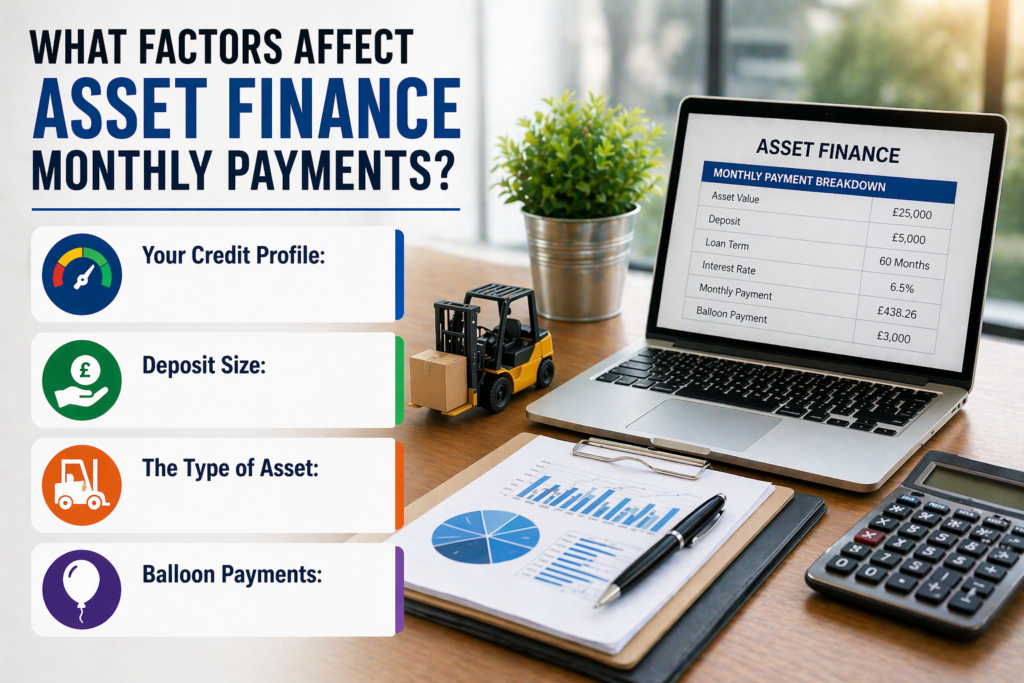
If you’ve ever played around with an equipment finance calculator UK, you might notice that a small change in one area makes a massive difference in your monthly bill. Here are the “big four” factors that move the needle:
- Your Credit Profile: Just like a personal loan, the healthier your business’s balance sheet, the lower the interest rate you’ll be offered.
- Deposit Size: The more you pay upfront, the less you’re borrowing. It’s the simplest way to calculate asset finance payments that fit a tighter monthly budget.
- The Type of Asset: Lenders love “hard” assets (tractors, trucks) because they hold their value. “Soft” assets (software, fit-outs) might carry slightly higher rates because they are harder to resell.
- Balloon Payments: Some UK businesses choose a “balloon” or “residual value” at the end of the term. It makes your monthly payments much lower, but you’ll owe a larger lump sum at the very end.
How Can I Calculate the Total Cost of Asset Finance?
Many business owners make the mistake of only looking at the monthly figure. To truly understand the impact on your bottom line, you need to look at the “Total Cost of Credit.”
To find this, take your monthly payment and multiply it by the number of months in the term. Then, add your initial deposit and any “option to purchase” fees at the end.
“Example: > If your monthly payment is £1,000 for 60 months, with a £5,000 deposit:”
(£1,000 x 60) + £5,000 = £65,000 total
“If the equipment costs £55,000, your total cost of finance is £10,000. Using an asset finance calculator helps you see this total figure instantly, allowing you to weigh the cost of the loan against the extra revenue that the new piece of kit is going to generate.”
How Much Will I Pay Monthly With Asset Finance?
While every deal is custom, UK rates currently vary. For a quick mental estimate:
For a £50,000 machine over 5 years with a 10% deposit, you might see payments ranging from £850 to £1,100 per month, depending on your credit score and the current Bank of England base rate.
The beauty of an asset finance calculator is that it lets you “stress test” your budget. You can see what happens if rates go up by 1%, or if you decide to pay the loan off over three years instead of five to save on total interest.
Is There A Free Asset Finance Calculator For UK Businesses?
Absolutely. You don’t need to pay for financial modeling software to get these answers. Most reputable UK brokers and lenders provide these tools for free on their websites.
However, a calculator is only as good as the data behind it. Generic calculators might use “teaser rates” that only the top 1% of businesses qualify for. For a realistic view, it’s often better to use a tool provided by a specialist who understands the current UK lending appetite.
How Best Asset Finance Can Help
This is exactly where Best Asset Finance enters the frame. While a digital asset finance calculator UK is a fantastic starting point, it can’t tell you which lender currently has the best spot for your specific industry.
Best Asset Finance combines the speed of digital tools with the nuance of human expertise. We don’t just give you a generic number; we help you navigate the different structures to see which one offers the best tax advantages for your specific setup.
Instead of you spending hours on an equipment finance calculator, their team does the heavy lifting, matching you with a panel of lenders to ensure the “estimate” you saw on the calculator becomes a reality in your bank account.
Also Read:- Asset Finance and VAT UK: How VAT Works on Leasing and Hire Purchase Explained
Final Thoughts: Look Before You Leap
Asset finance is one of the most powerful ways to grow a business without draining your cash reserves. But as with any financial commitment, knowledge is power.
By starting with an asset finance calculator, you move from a place of “I hope we can afford this” to “I know this investment makes sense.” Take the time to play with the numbers, look at the total cost, and speak to the pros to turn those calculations into a growth strategy.
FAQs
Q: Does using an asset finance calculator affect my credit score?
Ans: No! A calculator is just a math tool. You can run as many scenarios as you like without leaving any footprint on your credit file.
Q: Is the rate on the calculator guaranteed?
Ans: Usually, no. The asset finance calculator provides an estimate based on average market rates. Your final offer will depend on a full credit assessment.
Q: Can I use the calculator for used equipment?
Ans: Yes! Most equipment finance calculatortools work for both new and used kit, though interest rates for older machinery can sometimes be slightly higher.
Q: Should I include VAT in the calculator?
Ans: It depends on the product. With Hire Purchase, you usually pay the full VAT upfront as a deposit. With a Lease, the VAT is spread across the monthly payments.
Q: How accurate are these tools?
Ans: They are mathematically perfect, but they rely on the interest rate you input. Always treat the result as a “highly educated estimate” until you get a formal quote.
Discover the Latest Trends
Stay informed with our latest articles and resources.