Asset Finance Interest Rates UK 2026
In the ever-shifting landscape of the British economy, 2026 has arrived with a mixture of cautious optimism and “higher-for-longer” reality checks. For business owners and finance directors, the number one question on the table remains the same: where are the rates going, and how does it affect our ability to grow?
Specifically, when we talk about asset finance interest rates, we’re looking at the cost of the “tools of the trade”—everything from the CNC machines in a Birmingham workshop to the electric delivery fleets in London.
The Big Picture: Where Are We Now?
As of March 2026, the Bank of England (BoE) Base Rate stands at 3.75% (Bank of England, 2026). If you’ve been following the news, you’ll know it is a significant drop from the 15-year highs we saw in 2023, but it hasn’t quite hit the “rock bottom” levels many had hoped for by now.
The reason? A complex cocktail of geopolitical shocks in late 2025 and stubborn service-sector inflation. While the BoE had initially signalled a more aggressive cutting cycle, the current consensus is that we may only see one or two more small reductions this year, potentially landing us at 3.25% or 3.5% by December.
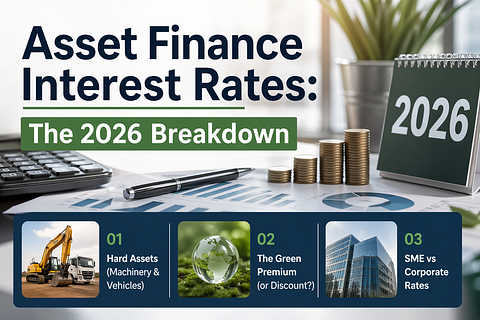
Asset Finance Interest Rates: The 2026 Breakdown
When you’re looking for asset finance—be it through hire purchase, leasing, or refinancing—you aren’t just paying the Base Rate. Lenders add a margin to cover their risk and operational costs. In 2026, the market for asset finance interest rates has become highly bifurcated. Here is what we are seeing across the board:
1. Hard Assets (Machinery & Vehicles)
- For “hard” assets (tractors, heavy plant, and HGVs) with strong resale value, rates remain relatively competitive. Because the lender has high-quality security in the physical asset, they can often offer tighter margins.
- Growth in plant and machinery finance surged by 21% recently, showing that despite higher rates, businesses are still hungry to modernise.
2. The Green Premium (or Discount?)
- Sustainability is no longer a “nice to have.” In 2026, many lenders are offering “Green Asset Finance” with rates that are 0.5% to 1% lower than standard packages for electric vehicles or renewable energy infrastructure.
3. SME vs Corporate Rates
- Interestingly, SMEs have been the powerhouse of the asset finance sector lately. New lending to SMEs grew by 4% over the last year, reaching a record £24 billion. However, SMEs typically face slightly higher margins than blue-chip corporations due to the perceived risk in a stalling economy where GDP growth is hovering around 1.0%.
Why Asset Finance is Still the “Smart Play”
You might wonder: “If rates are still above 3%, why not just wait?” In 2026, the cost of not investing is often higher than the interest rate. With the UK’s productivity gap still wider than that of our G7 neighbours, those who delay upgrading their tech or machinery are falling behind. Best Asset finance allows you to:
- Preserve Cash: Keep your “rainy day” fund intact while the economy remains volatile.
- Tax Efficiency: Leasing and Hire Purchase still offer significant tax-deductible benefits.
- Beat Inflation: If you lock in a fixed-rate deal now and equipment prices rise later in the year, you’ve effectively hedged your costs.
Finding the Best Asset Finance UK Firm in 2026
While asset finance interest rates are the headline act, the “best” firm isn’t always the one with the lowest percentage on paper. In 2026, the UK market is incredibly diverse, ranging from high-street giants like Lombard to agile, specialist challengers like the Best Asset Finance UK. We can help you by:
- Tailoring Repayment Structures to Your Cash Flow:
We don’t believe in “one size fits all.” Whether you need seasonal payment skips for agricultural machinery or “low-start” profiles for new production lines, we match the repayment schedule to when your new asset actually starts generating revenue.
- Accessing Exclusive “Wholesale” Rates:
Through our deep-rooted relationships with a panel of over 50 Tier-1 and specialist lenders, we can often secure asset finance interest rates that aren’t available to the general public or through direct-to-bank applications.
- Providing Sector-Specific Expertise:
From CNC robotics to solar arrays, we understand the residual value of your specific equipment. This expertise allows us to move faster than generalist banks, often securing approvals in hours rather than weeks.
- Future-Proofing Your Credit Lines:
By diversifying your funding away from your primary business bank, we help you keep your traditional overdrafts and loan facilities clear for day-to-day operational needs, ensuring your business remains resilient regardless of BoE rate shifts.
Also Read:- Leasing vs Hire Purchase: Which Is More Tax Efficient?
The Verdict: A Year of “Steady as She Goes”
2026 isn’t a year for wild gambles, but it’s certainly not a year to hibernate. Asset finance interest rates are stable enough to allow for long-term planning. Whether you’re looking to digitise your operations or expand your fleet, the key is to shop around. The bank and broker-led markets are more active than ever, often outperforming the “Big Four” on flexibility.
FAQs
Q. What is the current UK Base Rate in March 2026?
Ans:- The Bank of England Base Rate is currently 3.75%, following a series of holds in early 2026.
Q. Are asset finance interest rates fixed or variable?
Ans:- Most asset finance agreements in the UK are fixed-rate, meaning your monthly payments won’t change even if the Bank of England raises or lowers rates later.
Q. Is it cheaper to finance “green” equipment?
Ans:- Generally, yes. Many UK lenders now offer discounted rates for low-carbon assets like EVs or solar panels to support Net Zero targets.
Q. How much did the asset finance market grow recently?
Ans:- The market grew by 1% overall in 2025, exceeding £40 billion in total new business.
Q. Will interest rates fall further in 2026?
Ans:- Market analysts predict a “slow and low” approach, with a potential drop to 3.25% by the end of the year, depending on inflation data.
Discover the Latest Trends
Stay informed with our latest articles and resources.